
If you want a firsthand experience and to be guided through Herzegovina by local guides, you can check out our offer: Mostar Tour | 5 Cities tour (Konjic, Blagaj, Počitelj, Kravice waterfalls and Mostar)
Are visiting Sarajevo and wondering which places you should explore beyond the capital? A day trip to Herzegovina is an experience you should not miss.
This journey takes you through five remarkable destinations: Konjic, Blagaj, Kravice Waterfalls, Počitelj and Mostar. Each place has its own character, history and beauty, offering a different perspective on Bosnia and Herzegovina.
But what makes this excursion particularly memorable is not just the destinations. It is everything you experience along the way: the stories shared by your guide, the changing landscapes, the historical details, the opportunities to relax and the freedom to enjoy each stop.
Here is what you can expect when joining Bosnia Day Tours for a full-day excursion from Sarajevo to Herzegovina.
8:00 AM – Departure from Sarajevo: The Journey Begins
Our day begins with a morning pickup in Sarajevo. At approximately 8:00 AM, we leave the city and start our journey towards Konjic, our first destination, located around one hour away.
Before setting off, the guide introduces the itinerary, explaining which places we will visit and approximately how much time we will spend at each destination. He also gives us a useful recommendation regarding lunch: rather than stopping for a meal earlier in the day, he suggests having lunch in Mostar, our final destination, where there is a much wider variety of restaurants and dining options.
As we leave Sarajevo behind, the guide begins introducing us to the history of Bosnia and Herzegovina.
Rather than simply driving between destinations, the journey becomes an introduction to the country’s past. He takes us through the history of the medieval Bosnian Kingdom, beginning around the 10th century, and explains how the region developed over the centuries.
One particularly interesting topic is the origin of the name Herzegovina. The guide introduces the historical figure Stjepan Vukčić Kosača, a powerful nobleman who used the title Herceg, derived from the German word Herzog, meaning duke. His title eventually gave the region its name: Herzegovina.
He also explains the geographical differences between Bosnia and Herzegovina, particularly the direction of their rivers. The Neretva and other rivers in Herzegovina flow towards the Adriatic Sea, while most rivers in Bosnia belong to the Black Sea drainage basin.
It is a fascinating introduction that helps you understand the country before you even reach the first stop.
Stop 1 – Konjic: The Gateway to Herzegovina
After approximately one hour of driving, we arrive in Konjic, a charming historic town situated along the beautiful Neretva River.
As we approach the town, the guide explains the story behind the name Konjic and introduces us to its historical importance.
Once we leave the vehicle, we begin exploring the historic centre. The guide takes us around the famous Old Bridge, explaining its history, architecture and importance to the town.
Konjic is often described as the gateway to Herzegovina, and its geographical position makes it an important connection between central Bosnia and the southern part of the country.
We learn about the town’s development, its relationship with the Neretva River and the significance of its historic landmarks.
Another fascinating subject introduced during this stop is Tito’s Bunker, officially known as the ARK D-0 Atomic War Command Centre.
The guide explains why former Yugoslav leader Josip Broz Tito ordered the construction of this enormous underground military facility, how it was financed and why its location was strategically important.
The bunker was designed as a secure command centre that could protect Yugoslavia’s leadership in the event of a nuclear attack. Its location near Konjic was carefully selected because of the surrounding mountains and the natural protection they offered.
Even if you do not visit the bunker itself, learning about its construction, purpose and history adds another interesting dimension to the journey.
After exploring Konjic and learning about its history, we continue south towards Blagaj.
Stop 2 – Blagaj: The Buna River Spring and Historic Dervish House
The journey from Konjic towards Blagaj is another opportunity to enjoy the scenery and learn more about the region.
Along the way, the guide makes sure everyone is comfortable and encourages guests to let him know if they need a break. We make a stop at a gas station where everyone has the opportunity to use the facilities, grab a coffee and stretch their legs.
As we continue, we pass through Jablanica, a town famous for its beautiful artificial lake and its connection to the Neretva River.
The guide explains how the lake was created and how the Neretva River accompanies us along much of our journey towards Mostar.
He also shares interesting historical information about Jablanica during the Bosnian War, which lasted from 1992 to 1995, including stories about electricity supply during that period.
As we get closer to Blagaj, the guide introduces us to the Buna River, explaining its course and pointing out the fish farms in the area.
He also recommends trying fresh fish at one of the traditional restaurants beside the river, particularly because of their proximity to the fish farms.
Discovering the Buna River Spring
Once we arrive in Blagaj, our first experience is visiting the famous Buna River spring.
The spring emerges directly from the base of a dramatic limestone cliff, creating a beautiful combination of crystal-clear water, towering rocks and surrounding greenery.
Standing in front of the spring, the guide explains its depth and the water temperature, which remains remarkably cold throughout the year, even during the hot summer months.
It is an impressive natural attraction and one of the most photographed locations in Herzegovina.
Visiting Blagaj Tekke – The Historic Dervish House
Our next visit is Blagaj Tekke, the historic Dervish house located right beside the Buna River spring.
There is an entrance fee of approximately €5 per person.
Before entering, the guide explains when the complex was established, its historical purpose and how it functioned as a largely self-sustaining religious and spiritual centre.
We also learn about the traditions of the Dervish community and their religious practices.
Once inside, one of the first things you notice is how cool and peaceful the interior feels compared with the warm temperatures outside.
The house has separate areas for men and women, reflecting the traditional arrangements of the complex.
After the historical introduction, we are given free time to explore independently, take photographs and appreciate the unique architecture and peaceful atmosphere.
There is also the opportunity to sit down and enjoy a traditional Bosnian coffee while taking in the beautiful surroundings.
Blagaj is one of those places where you naturally want to slow down and enjoy the moment before continuing the journey.
Stop 3 – Kravice Waterfalls: A Refreshing Escape into Nature
After visiting Blagaj, we continue towards our third destination: Kravice Waterfalls.
By this point, we have already experienced quite a lot of history and sightseeing, so the drive provides a welcome opportunity to relax. Some guests may even enjoy a short nap before arriving.
Kravice Waterfalls offer a completely different experience from the previous destinations.
Instead of historic streets and architectural landmarks, we find ourselves surrounded by nature, greenery and the sound of cascading water.
We are given approximately one hour of free time to explore and enjoy the area.
During summer, the guide recommends taking a swim if conditions and local regulations permit. Herzegovina experiences hot summers with a Mediterranean climate, and temperatures can become particularly high during July and August.
Cooling off in the refreshing water beneath the waterfalls is therefore a wonderful way to enjoy this stop.
Visitors can explore the surrounding area, take photographs, relax beside the water or simply enjoy the scenery.
There is also a restaurant where guests can have something to eat, enjoy refreshments or sit down for a coffee.
After an hour of relaxation and enjoying the natural surroundings, we continue towards our fourth destination.
Stop 4 – Počitelj: A Journey Through Ottoman History
Approximately half an hour later, we arrive in Počitelj, one of the most distinctive historic settlements in Herzegovina.
Built into a hillside overlooking the Neretva River, this historic stone village offers beautiful scenery and a fascinating glimpse into the region’s past.
Upon arrival, the guide takes us towards the upper part of the settlement, where we reach a viewing area near the fortress and enjoy panoramic views of the surrounding landscape.
From here, the guide begins explaining the history of Počitelj, its strategic importance and its development throughout the centuries.
We learn about its position overlooking the Neretva River and why this location was historically important for controlling movement through the valley.
The guide also shares interesting stories about the village’s bell tower. During wartime, the bell was reportedly removed and melted down to produce ammunition.
Another interesting topic is Počitelj’s heritage protection. The guide explains why the village has faced challenges in obtaining full UNESCO World Heritage inscription, including changes to traditional rooftops and the preservation of its original architectural character.
Počitelj is included on UNESCO’s Tentative List, reflecting its recognized cultural significance.
One of the most interesting parts of this stop is learning about the village’s population.
Although Počitelj was once a much livelier settlement, its population has decreased significantly over the years. As urbanization increased, many residents moved to larger cities in search of different opportunities.
Today, the village has a much smaller permanent population, giving it a quieter atmosphere than it once had.
The contrast between its historic importance and its present-day size makes Počitelj particularly interesting to explore.
It is also a wonderful place to take photographs, admire traditional stone architecture and enjoy the views of the Neretva Valley.
Stop 5 – Mostar: Discover the Famous Old Bridge and Historic Old Town
Our final destination is Mostar, approximately 30 minutes from Počitelj.
Mostar is one of the most famous cities in Bosnia and Herzegovina and a place that should be on every visitor’s itinerary.
Upon arrival, we park near the historic centre, allowing us to explore the main attractions on foot.
Stara Ćuprija – The Old Stone Bridge
Before reaching the famous Old Bridge, we stop at Stara Ćuprija, which translates to the Old Stone Bridge.
The guide introduces us to its history and explains its importance in the development of Mostar.
He also discusses its age and how it predates the famous Stari Most, offering an interesting perspective on the city’s historic bridges and architecture.
Stari Most – The Iconic Bridge of Mostar
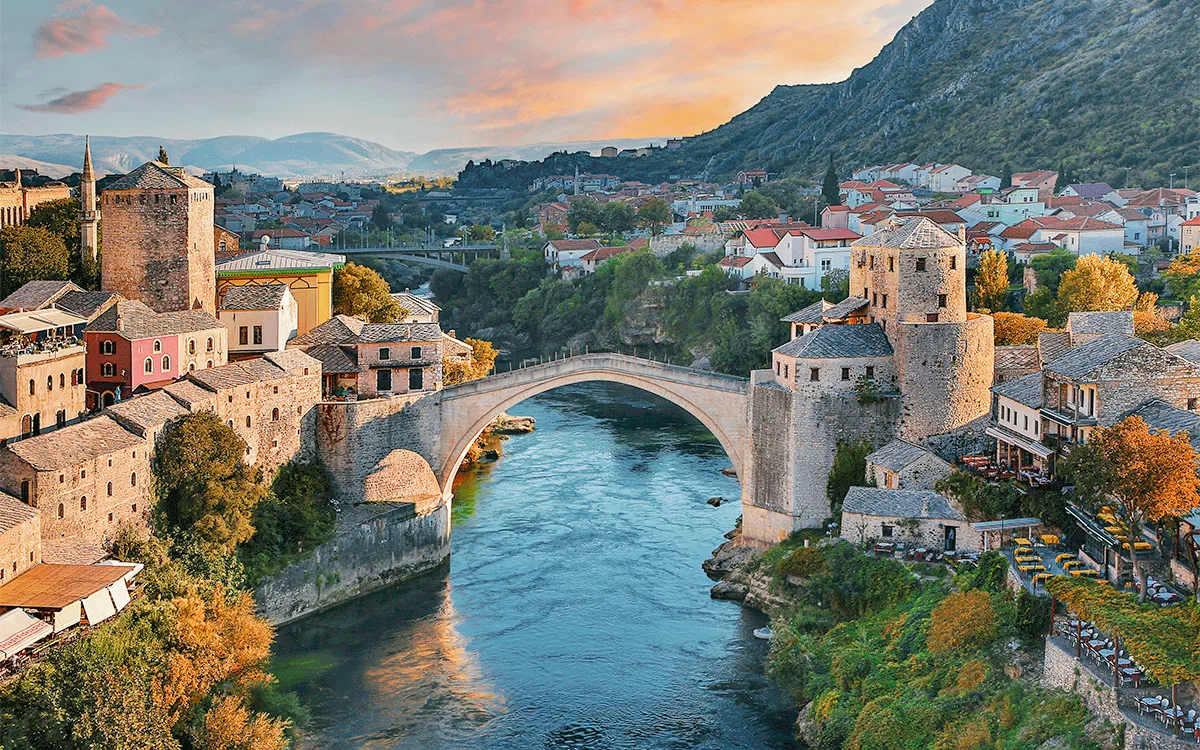
We then continue towards the main attraction: Stari Most, the famous Old Bridge.
Standing approximately 24 metres above the Neretva River, the bridge is one of the most recognizable landmarks in the entire country.
Here, the guide gives us a detailed explanation of its construction, history and importance.
Originally completed in 1566 during the Ottoman period, the bridge connected the two sides of Mostar and became a defining symbol of the city.
The guide shares several fascinating details about its architecture and construction, including the story of its architect, Mimar Hayruddin.
According to the historical account shared during the tour, the architect worked under enormous pressure, knowing that failure to complete a successful structure could have severe consequences.
We also learn about the bridge’s destruction during the Bosnian War in 1993 and its subsequent reconstruction, which was completed in 2004.
One of the most interesting details is that original stones from the destroyed bridge remain visible beneath the reconstructed structure. Visitors can sometimes see people sitting on these remains beside the river.
The Story Behind the Bridge’s 99 and 93 Steps
The guide also shares an interesting story connecting the number of steps associated with the bridge and the year it was destroyed.
He explains the traditional reference to 99 steps and the number 93, linking it to the tragic year 1993.
These small historical details make the visit more engaging and help visitors appreciate the stories behind the monument.
The Diving Tradition of Mostar
Mostar is also famous for its traditional bridge diving culture.
For generations, local divers have jumped from the Old Bridge into the cold waters of the Neretva River, turning this practice into one of the city’s most recognizable traditions.
The guide explains a local legend that a young man is considered to have become a man when he successfully completes the jump.
However, this is not something visitors should attempt without proper authorization and supervision. Diving from the bridge requires permission from the local diving club and appropriate preparation.
Watching the divers, when available, is an unforgettable experience and adds another unique element to the atmosphere of Mostar.
Free Time in Mostar – Explore, Eat and Enjoy
After the guided introduction to the bridge and the history of Mostar, we are given approximately one and a half hours of free time.
This is also the perfect opportunity for lunch, as recommended at the beginning of the tour.
Mostar offers a wide variety of restaurants, traditional Bosnian food, cafés and local specialties.
You can explore the Old Bazaar, browse traditional copper shops, purchase souvenirs, take photographs from different viewpoints or simply sit down and enjoy the atmosphere of the historic centre.
One and a half hours gives guests a comfortable opportunity to enjoy lunch and explore independently without feeling too rushed.
After a full day of discovering Herzegovina, Mostar provides a wonderful final destination before returning to Sarajevo.
The Journey Back to Sarajevo – Ending a Wonderful Day
After our free time in Mostar, we return to the vehicle and begin the journey back to Sarajevo.
By this point, we have visited five destinations, learned about centuries of history, explored beautiful natural attractions and experienced some of the most recognizable landmarks in Bosnia and Herzegovina.
The guide makes sure everyone is comfortable before departure and offers water bottles to anyone who needs them.
The return journey is more relaxed. After a full day of sightseeing, most guests are ready to rest, while others enjoy conversations with the guide.
It is also a great opportunity to ask final questions and receive recommendations about what else to see and do in Sarajevo.
The guide shares suggestions for other destinations, restaurants and experiences worth discovering during the remainder of our stay in Bosnia and Herzegovina.
It is a thoughtful way to finish the day, knowing that the experience goes beyond simply visiting tourist attractions.
Is the Sarajevo to Herzegovina Day Trip Worth It?
Absolutely. If you are visiting Bosnia and Herzegovina, we strongly recommend including Mostar and the surrounding region in your itinerary.
What makes this excursion special is the variety of experiences throughout the day.
You begin with the historic atmosphere of Konjic, discover the peaceful Buna River spring in Blagaj, cool off at Kravice Waterfalls, explore the historic settlement of Počitelj and finish in the beautiful Old Town of Mostar.
Each destination offers something different, and together they provide an excellent introduction to the history, culture and natural beauty of Herzegovina.
The guide also makes a significant difference. Instead of simply driving between locations, you learn about the country, its history, its people and the stories that make each destination unique.
With Bosnia Day Tours, the route is carefully organized to help you experience all five destinations in one day, with time for sightseeing, relaxation, lunch and independent exploration.
If you are planning a trip to Sarajevo, make sure you leave a day to discover Herzegovina.
Explore Bosnia. Experience its history. Discover Herzegovina with Bosnia Day Tours.